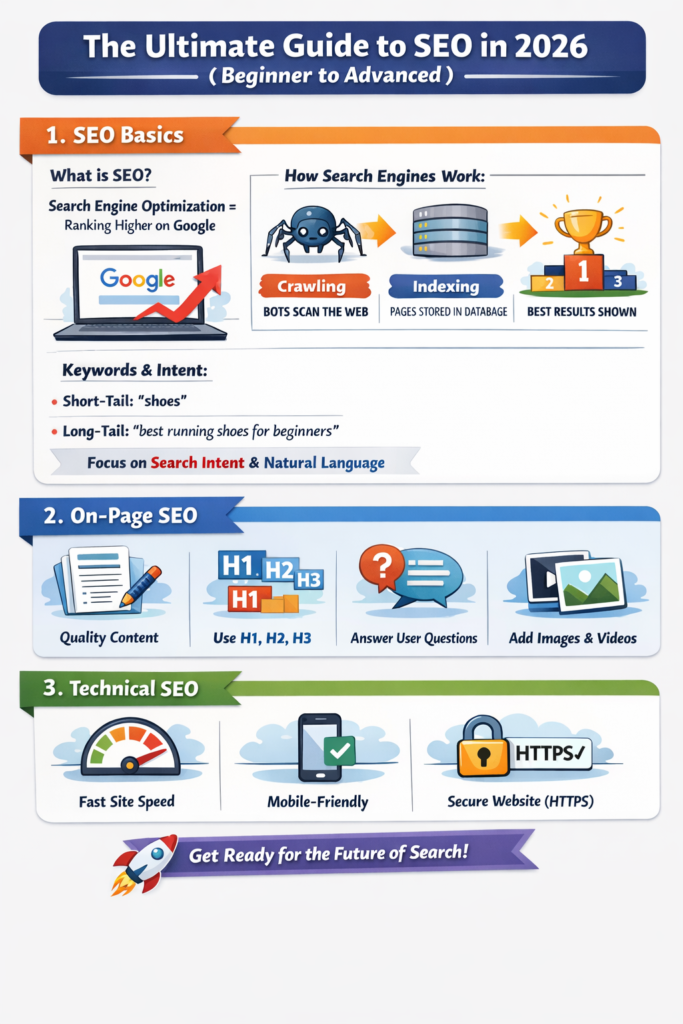
The Ultimate Guide to SEO in 2026 (Beginner to Advanced)
Search Engine Optimization (SEO) is the process of improving your website so that it ranks higher on search engines like Google. The higher your website ranks, the more organic (free) traffic you get.
In this blog, you’ll learn what SEO is, why it matters, and how to build a strong SEO strategy step-by-step.
📌 What is SEO?
SEO (Search Engine Optimization) is the practice of optimizing your website to:
- Rank higher on search engines
- Increase website traffic
- Generate leads and sales
- Build online authority
Whenever someone searches for something on Google, SEO helps your website appear in those results.
🎯 Why SEO is Important in 2026
- 📈 Increases organic traffic
- 💰 Reduces paid advertising cost
- 🏆 Builds brand credibility
- ⏳ Gives long-term results
- 📍 Helps in local visibility
SEO is not a one-time task — it’s a continuous process.
🔎 Types of SEO
1️⃣ On-Page SEO
On-page SEO refers to optimizations done inside your website.
Key elements:
- Keyword research
- Title tags & meta descriptions
- Header tags (H1, H2, H3)
- Internal linking
- Image optimization
- Content quality
👉 Tip: Focus on user intent, not just keywords.
2️⃣ Off-Page SEO
Off-page SEO focuses on building authority through external signals.
Main factors:
- Backlinks
- Social sharing
- Guest posting
- Brand mentions
The more high-quality websites link to you, the more trustworthy your site looks to Google.
3️⃣ Technical SEO
Technical SEO ensures that search engines can properly crawl and index your site.
Important areas:
- Website speed
- Mobile-friendliness
- XML sitemap
- Secure website (HTTPS)
- Structured data
Technical issues can stop your site from ranking — even if your content is great.
4️⃣ Local SEO
Local SEO helps businesses rank in location-based searches.
For example:
- “Best cafe near me”
- “Digital marketing agency in Delhi”
Tools like Google Business Profile help businesses appear in map results.
🧠 How Search Engines Work
Search engines work in three main steps:
- Crawling – Bots scan websites
- Indexing – Content is stored in a database
- Ranking – Pages are ranked based on relevance & authority
Your job is to make your website easy to crawl, valuable to users, and trustworthy.
📝 Step-by-Step SEO Strategy
Step 1: Keyword Research
Find what your audience is searching for using tools like:
- Google Keyword Planner
- Ahrefs
- SEMrush
Focus on:
- Search volume
- Competition
- Search intent
Step 2: Create High-Quality Content
Content should:
- Solve real problems
- Be well-structured
- Include keywords naturally
- Provide value
Remember: Content is king 👑
Step 3: Build Backlinks
Ways to build backlinks:
- Guest posting
- Creating shareable content
- Outreach to bloggers
- Digital PR
Quality matters more than quantity.
Step 4: Improve Website Speed
A fast website improves:
- User experience
- Bounce rate
- Search rankings
Use tools like:
- Google PageSpeed Insights
Step 5: Track and Analyze
Monitor performance using:
- Google Analytics
- Google Search Console
Track:
- Traffic
- Keyword rankings
- Click-through rate (CTR)
- Conversions
⚠️ Common SEO Mistakes to Avoid
- Keyword stuffing
- Ignoring mobile users
- Buying spam backlinks
- Duplicate content
- Not updating old content
🔮 Future of SEO
SEO is becoming more focused on:
- User experience (UX)
- AI-driven search results
- Voice search optimization
- Helpful, people-first content
Search engines are smarter than ever. Focus on helping users — rankings will follow.
🏁 Final Thoughts
SEO is one of the most powerful digital marketing strategies for long-term growth. Whether you run a blog, eCommerce store, or local business, investing in SEO can bring consistent traffic and revenue.
Leave a Reply